The World's 10 Biggest Arms Exporters, 2021–2025
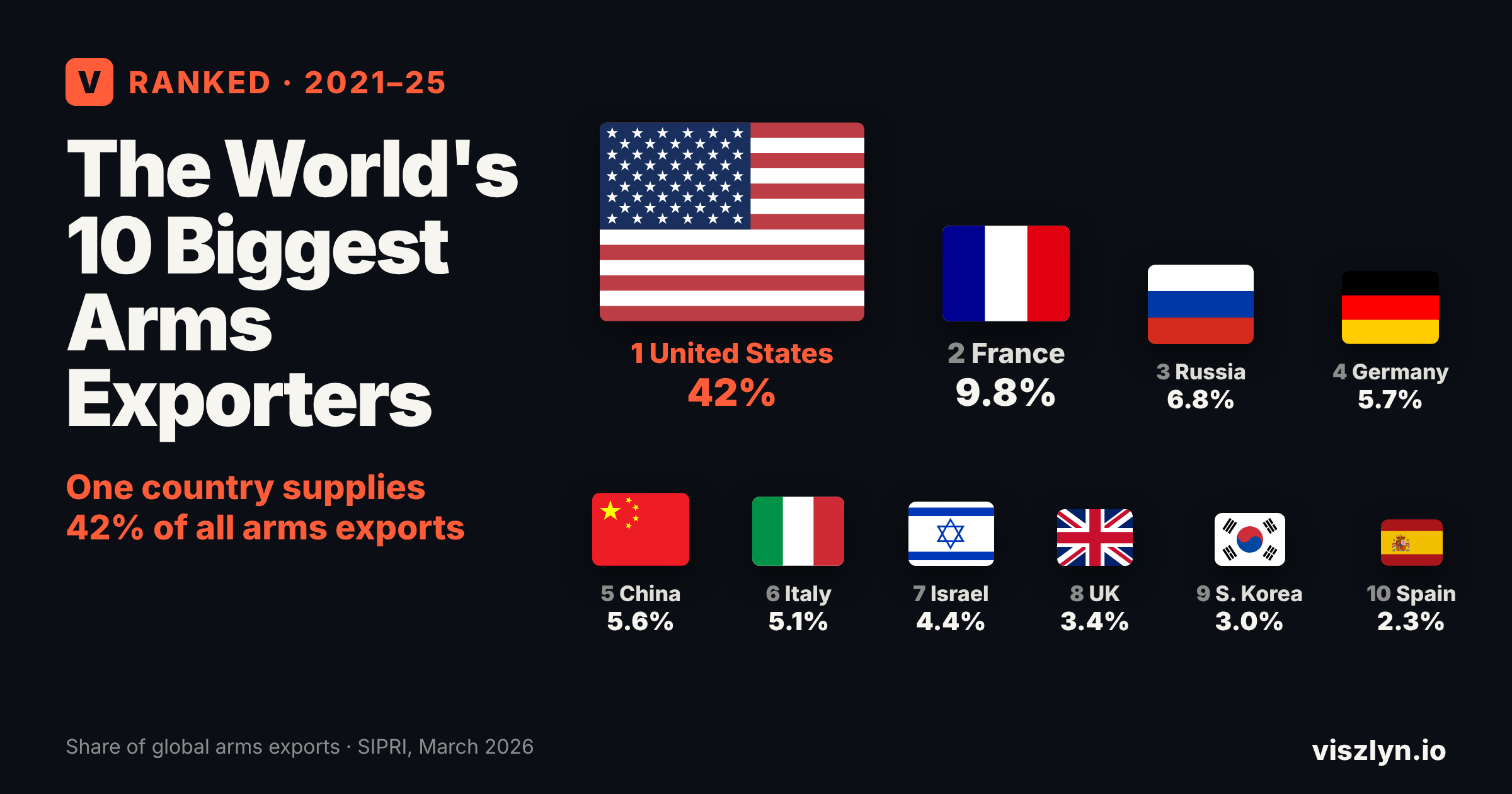
Global arms transfers grew 9.2% in 2021–25, the biggest increase since 2011–15. The United States now supplies 42% of the world's arms exports, while Russia's share fell from 21% to 6.8%.
Quick Answer
The United States was the world's biggest arms exporter in 2021–25, with 42% of global arms exports, more than the next seven suppliers combined. France was second with 9.8%, followed by Russia (6.8%), Germany (5.7%) and China (5.6%). Russia's share fell from 21% in 2016–20, and it is the only top-10 exporter whose export volume fell.
This ranking uses the Stockholm International Peace Research Institute (SIPRI), which tracks international transfers of major arms such as aircraft, ships, missiles and armoured vehicles. SIPRI compares five-year periods, because deliveries are uneven from year to year, so this ranking covers 2021–25 and compares it with 2016–20. Shares are based on SIPRI's Trend Indicator Value (TIV), which measures the volume of military hardware transferred, not its price in dollars. According to SIPRI, global arms transfers in 2021–25 were 9.2% higher than in 2016–20, the biggest increase since 2011–15.
These figures measure volume, not dollars
SIPRI's Trend Indicator Value (TIV) is a standard unit based on the military capability of the weapons transferred, not their sale price, so the shares here show how much military hardware each country supplied rather than how much money it earned. SIPRI notes its figures are often estimates. Two weak spots it flags: US exports to Ukraine in 2025, where increased secrecy makes reliable estimates difficult, and Algeria's imports, which may be underestimated.
Share of global arms exports, 2021–25 (%)
Source: SIPRI Arms Transfers Database, March 2026Tap any country to jump to its full breakdown below.
Ranked #10 to #1
- Share of global arms exports:
- 2.3%
- Category:
- Europe
Spain's share was almost unchanged, at 2.4% in 2016–20 and 2.3% in 2021–25, while its export volume rose 6.7%.
Saudi Arabia is Spain's biggest customer, taking 28% of Spanish arms exports, followed by Türkiye (16%) and Belgium (12%).
Source: SIPRI Arms Transfers Database, March 2026
- Share of global arms exports:
- 3.0%
- Category:
- Asia-Pacific
South Korea's arms exports rose 24% compared with 2016–20, lifting its share from 2.6% to 3.0%.
Poland takes 58% of South Korea's arms exports, followed by the Philippines (18%) and the UAE (9.5%).
Source: SIPRI Arms Transfers Database, March 2026
- Share of global arms exports:
- 3.4%
- Category:
- Europe
UK arms exports rose 13% compared with 2016–20, for a 3.4% share of the global total.
Qatar is the UK's biggest customer, with 31% of British arms exports, followed by the United States (14%) and Ukraine (13%).
Source: SIPRI Arms Transfers Database, March 2026
- Share of global arms exports:
- 4.4%
- Category:
- Middle East
Israel's arms exports rose 56% compared with 2016–20, lifting its share from 3.1% to 4.4%.
India is Israel's biggest customer, taking 29% of Israeli arms exports, followed by Germany (21%) and the United States (7.8%).
Source: SIPRI Arms Transfers Database, March 2026
- Share of global arms exports:
- 5.1%
- Category:
- Europe
Italy's arms exports rose 157% compared with 2016–20, the biggest increase of any top-10 exporter, more than doubling its share from 2.2% to 5.1%.
Qatar (26%), Kuwait (17%) and Indonesia (12%) are Italy's three biggest customers.
Source: SIPRI Arms Transfers Database, March 2026
- Share of global arms exports:
- 5.6%
- Category:
- Asia-Pacific
China's arms exports rose 11% compared with 2016–20, for a 5.6% share of the global total.
Pakistan takes 61% of China's arms exports, the highest share any single customer has with a top-10 exporter.
Source: SIPRI Arms Transfers Database, March 2026
- Share of global arms exports:
- 5.7%
- Category:
- Europe
Germany's arms exports rose 15% compared with 2016–20, for a 5.7% share of the global total.
Ukraine is Germany's biggest customer, with 24% of German arms exports, followed by Egypt (14%) and Israel (10%).
Source: SIPRI Arms Transfers Database, March 2026
- Share of global arms exports:
- 6.8%
- Category:
- Europe/Asia
Russia's arms exports fell 64% compared with 2016–20, and its share of the global total dropped from 21% to 6.8%. It is the only top-10 exporter whose export volume fell.
India is still Russia's biggest customer by far, taking 48% of Russian arms exports, followed by China (13%) and Belarus (13%).
Source: SIPRI Arms Transfers Database, March 2026
- Share of global arms exports:
- 9.8%
- Category:
- Europe
France's arms exports rose 21% compared with 2016–20, lifting its share from 8.8% to 9.8% and making it the world's second-biggest arms exporter.
India is France's biggest customer, taking 24% of French arms exports, followed by Egypt (11%) and Greece (10%).
Source: SIPRI Arms Transfers Database, March 2026
- Share of global arms exports:
- 42%
- Category:
- Americas
The United States' arms exports rose 27% compared with 2016–20, lifting its share of the global total from 36% to 42%, more than four times France's share.
Its biggest customers are Saudi Arabia (12%), Ukraine (9.4%) and Japan (8.9%). Its 42% share is more than the next seven exporters combined (40.8%).
Source: SIPRI Arms Transfers Database, March 2026
What the numbers tell us
Two other shifts stand out on the importing side. Ukraine went from 0.1% of global arms imports in 2016–20 to 9.7% in 2021–25, making it the world's biggest arms importer, supplied mainly by the United States (41%), Germany (14%) and Poland (9.4%). India, the world's second-biggest importer with 8.2%, now buys less from Russia: Russia's share of India's arms imports dropped from 70% in 2011–15 to 40% in 2021–25, while France (29%) and Israel (15%) together supplied 44%.
- Data period:
- 2021–25 (five-year period), compared with 2016–20
- Last updated:
- November 10, 2026
- Sources:
- Stockholm International Peace Research Institute (SIPRI), "Trends in International Arms Transfers, 2025", SIPRI Fact Sheet, March 2026 (DOI: 10.55163/OSMS3959), based on the SIPRI Arms Transfers Database.
Shares and changes are based on SIPRI's Trend Indicator Value (TIV), which measures the volume of major arms transferred using a standard unit, not the financial value of the deals. Shares are shown as SIPRI publishes them (one decimal place below 10%, whole numbers above), so they may not add up exactly. Percentage changes compare the volume of exports in 2021–25 with 2016–20. Customer shares are each recipient's share of that exporter's arms exports. The "next seven combined" total (40.8%) is calculated by Viszlyn from SIPRI's shares. SIPRI notes that its figures are often estimates, and flags US arms exports to Ukraine in 2025 and Algeria's imports as particularly uncertain.
Figures marked as estimates are based on publicly available information and may vary from other published sources.
Frequently Asked Questions
The United States, with 42% of global arms exports in 2021–25 according to SIPRI. That is more than four times the share of France, the second-biggest exporter, at 9.8%.