The 10 Most Distant Galaxies Ever Observed
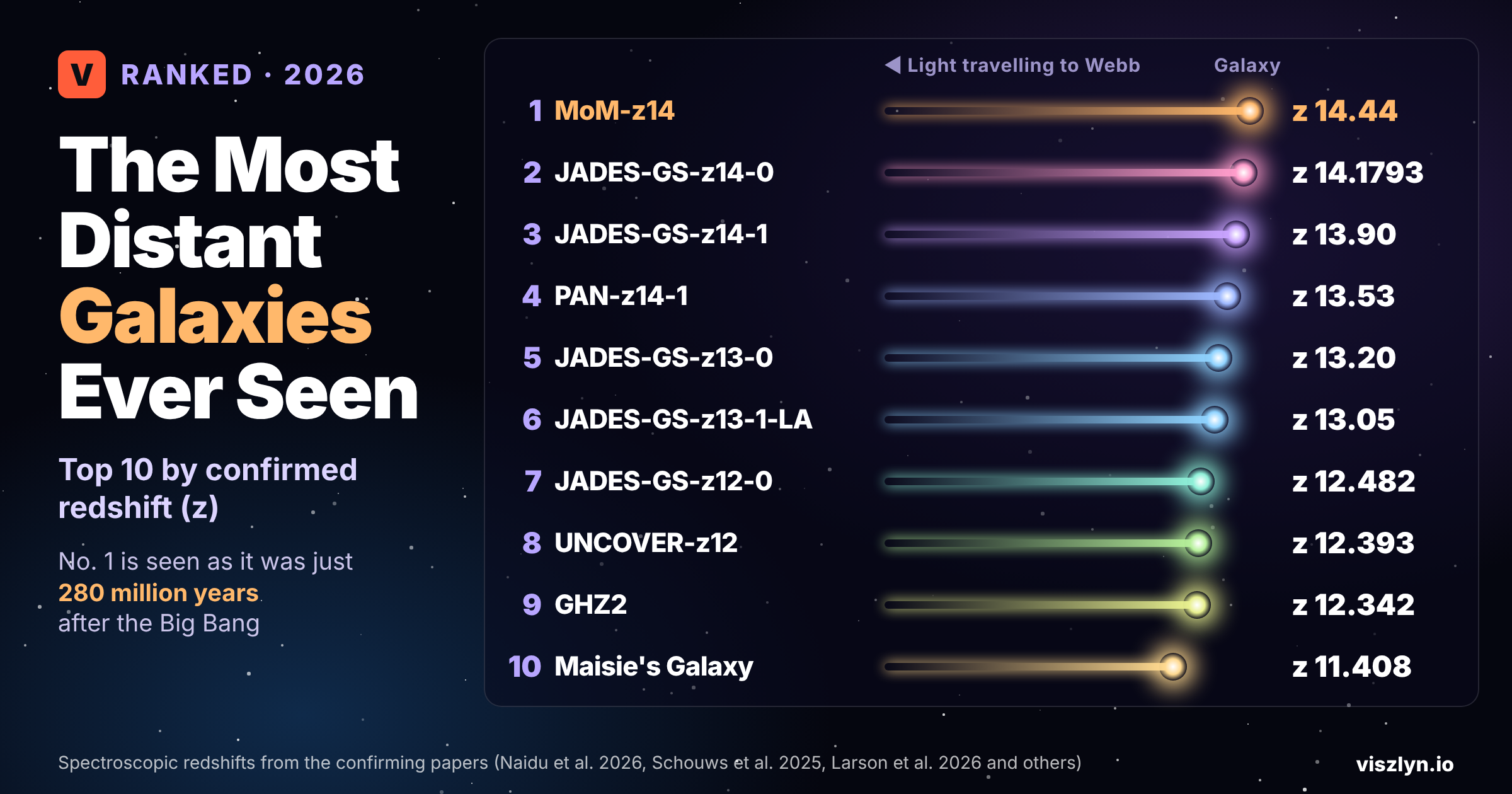
Every galaxy in this top 10 was confirmed by spectroscopy, not estimated from photographs. The record holder, MoM-z14, is seen as it was just 280 million years after the Big Bang.
Quick Answer
MoM-z14 is the most distant galaxy ever observed, with a spectroscopically confirmed redshift of 14.44 (+0.02/−0.02). NASA announced the record on January 28, 2026: the galaxy is seen as it was 280 million years after the Big Bang, and its light travelled about 13.5 billion years to reach the James Webb Space Telescope. Second is JADES-GS-z14-0 at 14.1793, a former record holder whose redshift was later refined by the ALMA observatory.
All 10 galaxies in this ranking were confirmed the hard way: by spectroscopy, splitting their light to measure a redshift directly, rather than estimating a distance from brightness and colour in photographs. Nearly all were found and confirmed with the James Webb Space Telescope, most of them in the last three years. For scale, the universe is 13.787 ± 0.020 billion years old (Planck Collaboration, 2020), and the observable universe has a radius of about 46.5 billion light-years (Gott et al., 2005). Every galaxy below is seen within the first few hundred million years of that history.
Why this list uses spectroscopy only
Photometric redshifts, estimated from images, have produced false records before. CEERS-93316 was announced in 2023 as a galaxy at a redshift of about 16.45; spectroscopy showed it is actually a dusty galaxy at redshift 4.912. Maisie's Galaxy and GHZ2, both in this top 10, also began as photometric claims (about 14 and about 13.1) before spectroscopy confirmed them at lower redshifts. Only spectroscopically confirmed galaxies are ranked here.
Spectroscopic redshift (z)
Source: Confirming papers listed under Sources; spectroscopic redshifts onlyTap any galaxy to jump to its details below.
Ranked #10 to #1
Maisie's Galaxy
JWST NIRSpec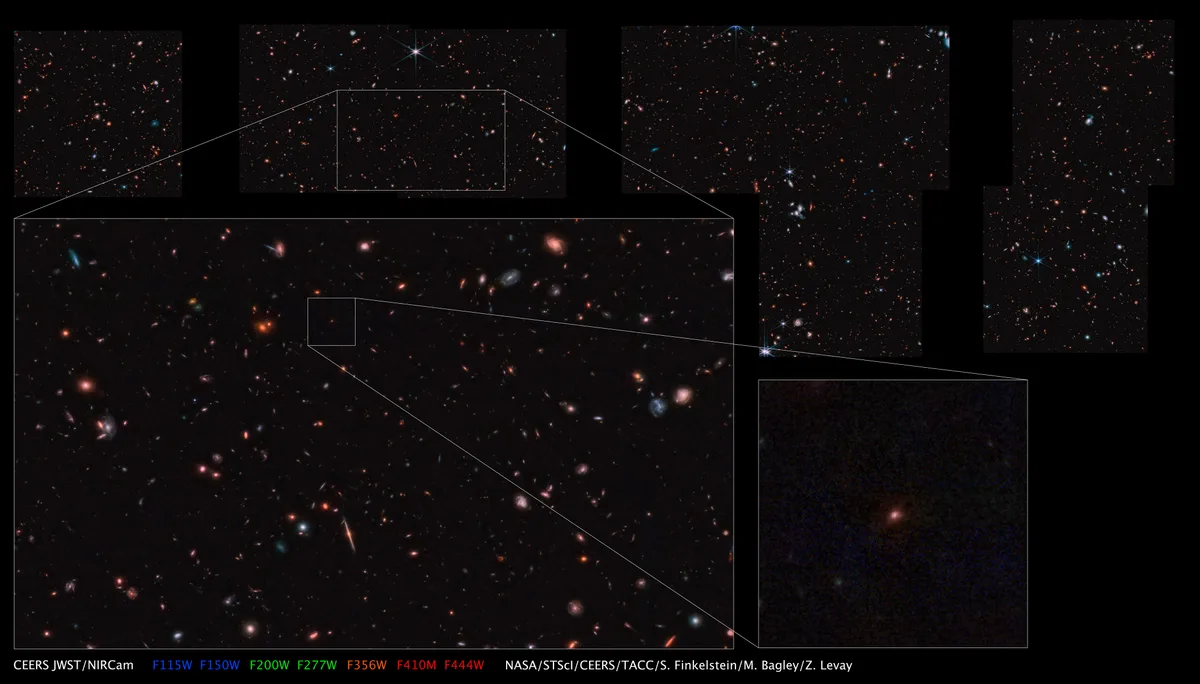
- Spectroscopic redshift:
- z = 11.408 ± 0.005
- Category:
- CEERS · EGS field
Maisie's Galaxy (catalogued as CEERS 16943) was confirmed by Arrabal Haro et al. (2023) in the CEERS survey's EGS field at a redshift of 11.416 ± 0.005. A deep spectroscopic follow-up by Larson et al. (2026) measured 11.408 ± 0.005, the value it is ranked by here. The confirming paper dates its light to 392 million years after the Big Bang; the University of Texas at Austin release says 390 million years.
It was publicised in the summer of 2022 as a galaxy at a redshift of about 14; spectroscopy put it at 11.416 in 2023, refined to 11.408 in 2026.
Source: Larson et al. 2026 (arXiv:2607.08749); Arrabal Haro et al. 2023, Nature 621, 707–711
GHZ2 (GLASS-z12)
JWST NIRSpec; also ALMA and JWST/MIRI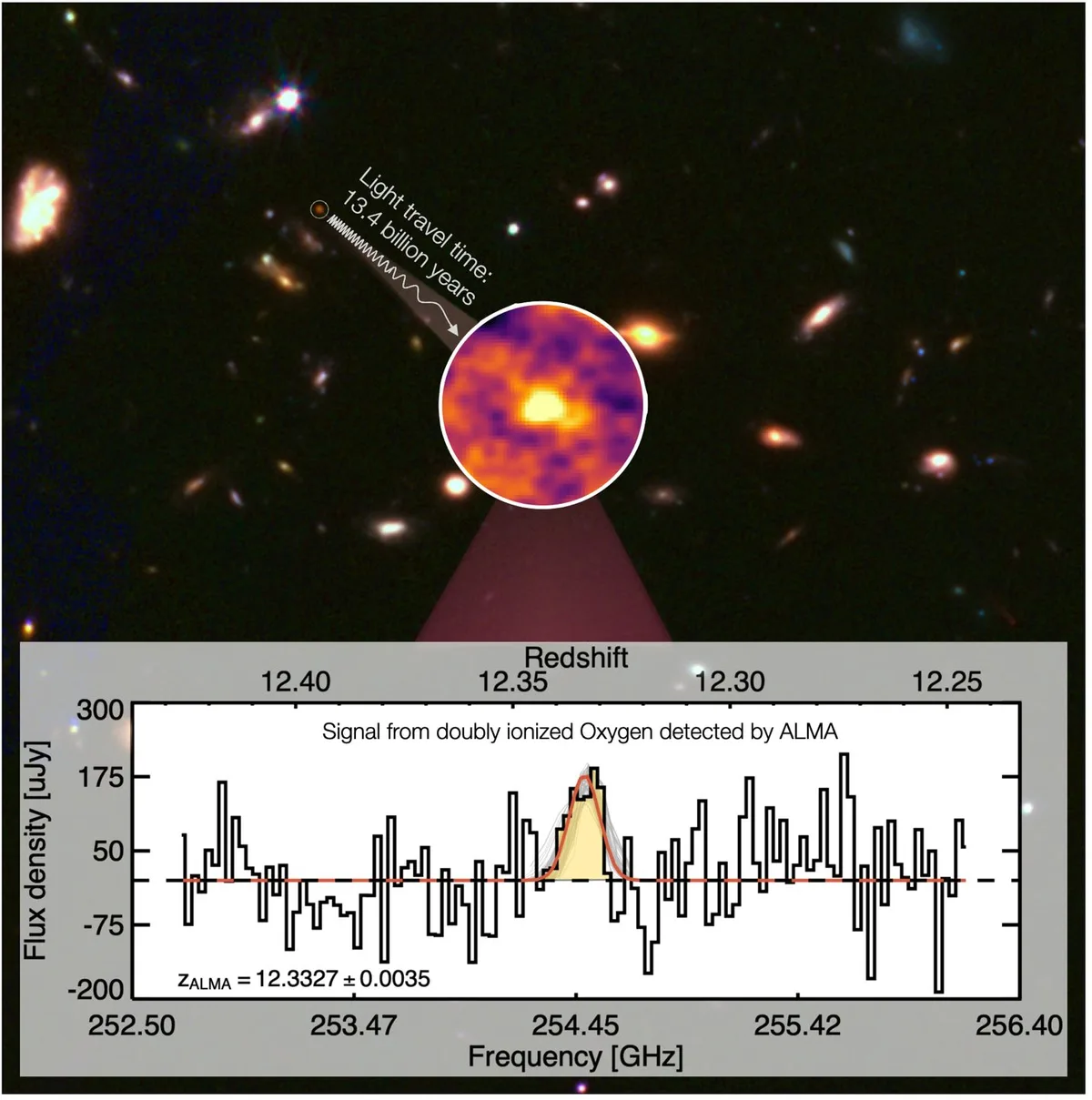
- Spectroscopic redshift:
- z = 12.342 ± 0.009
- Category:
- GLASS · Abell 2744
GHZ2, also known as GLASS-z12, was confirmed by Castellano et al. (2024) in the GLASS survey's Abell 2744 field. The ALMA Observatory dates it to approximately 400 million years after the Big Bang, with a light travel time of 13.4 billion years.
It is the most cross-checked galaxy on this list: ALMA measured 12.3327 ± 0.0035 and JWST's MIRI instrument 12.33 ± 0.02, both matching the NIRSpec value. It was announced in 2022 as “GLASS-z13” from a photometric estimate of about 13.1.
Source: Castellano et al. 2024, ApJ 972, 143
UNCOVER-z12
JWST NIRSpec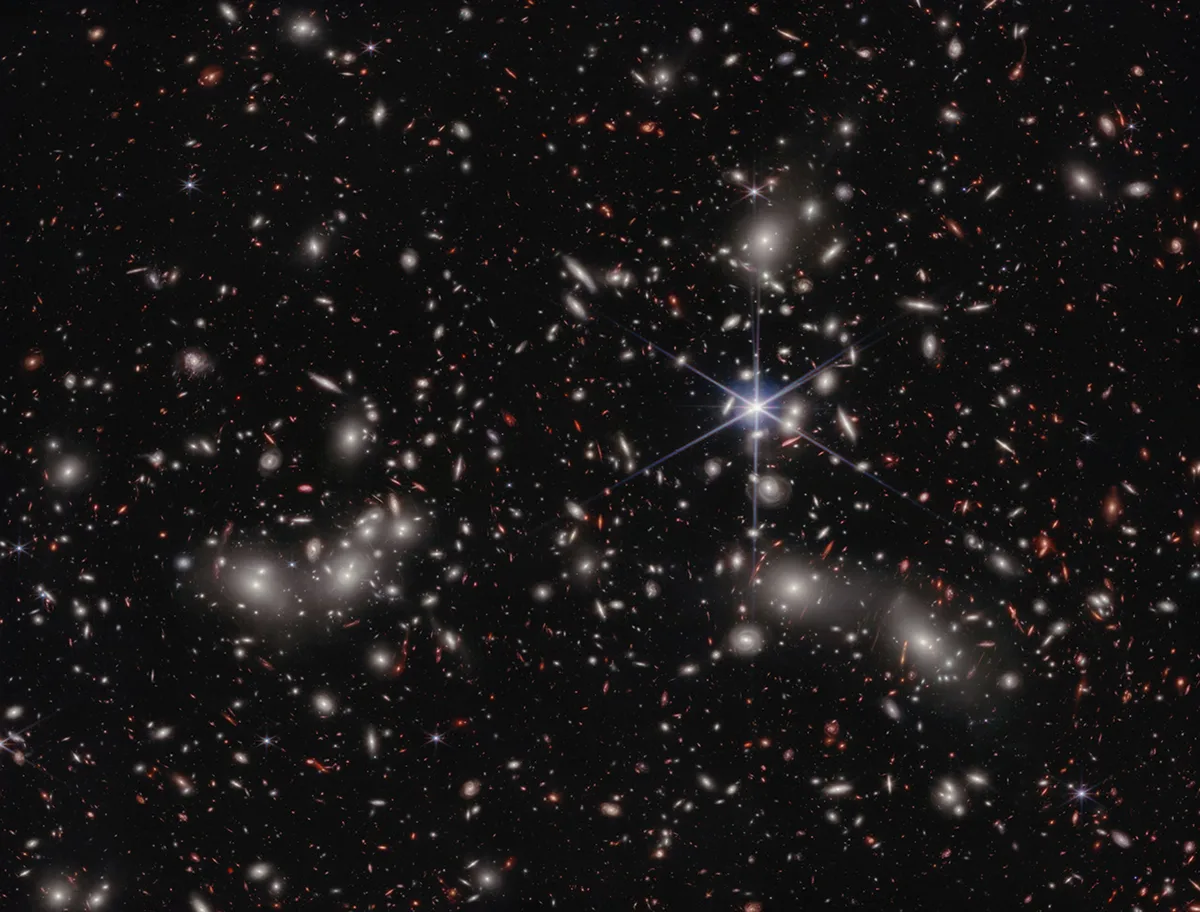
- Spectroscopic redshift:
- z = 12.393 (+0.004/−0.001)
- Category:
- UNCOVER · Abell 2744
UNCOVER-z12 is the robust detection of the pair reported by Wang et al. (2023) in the UNCOVER survey of Abell 2744 (Pandora's Cluster). The UNCOVER release dates the pair's light to when the universe was about 330 million years old, a light travel time of about 13.4 billion years.
Its companion in the same paper, UNCOVER-z13 (13.079), is not ranked here because the authors call it tentative; z12 is the detection they call robust.
Source: Wang et al. 2023, ApJ Letters 957, L34
JADES-GS-z12-0
JWST NIRSpec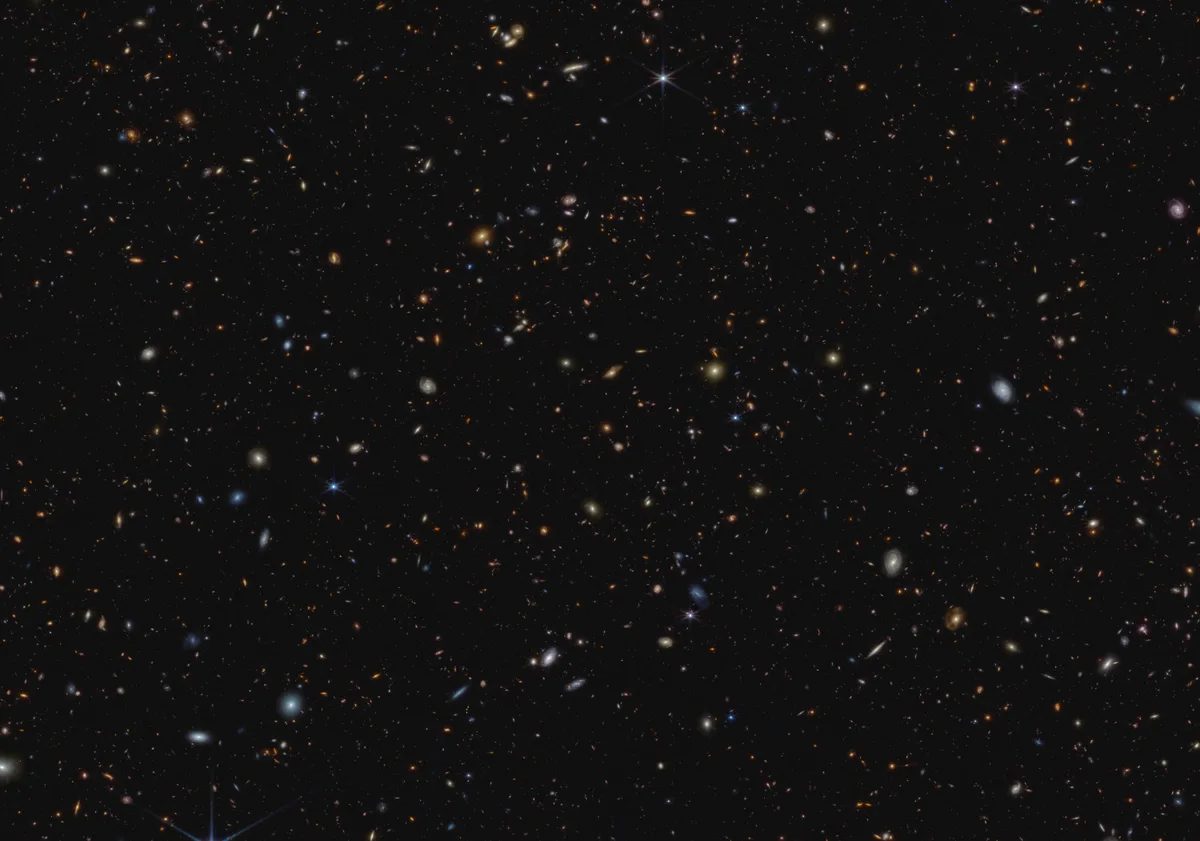
- Spectroscopic redshift:
- z = 12.482 ± 0.012
- Category:
- JADES · GOODS-S
JADES-GS-z12-0's ranked redshift comes from D'Eugenio et al. (2024), who measured its emission lines with JWST's NIRSpec in the JADES GOODS-S field. The confirming paper's title dates the galaxy to 350 Myr after the Big Bang.
Its first published redshift, 12.63 from the Lyman-alpha break, was too high because damped Lyman-alpha absorption had shifted the break; the emission-line value of 12.482 supersedes it.
Source: D'Eugenio et al. 2024, Astronomy & Astrophysics
JADES-GS-z13-1-LA
JWST NIRSpec PRISM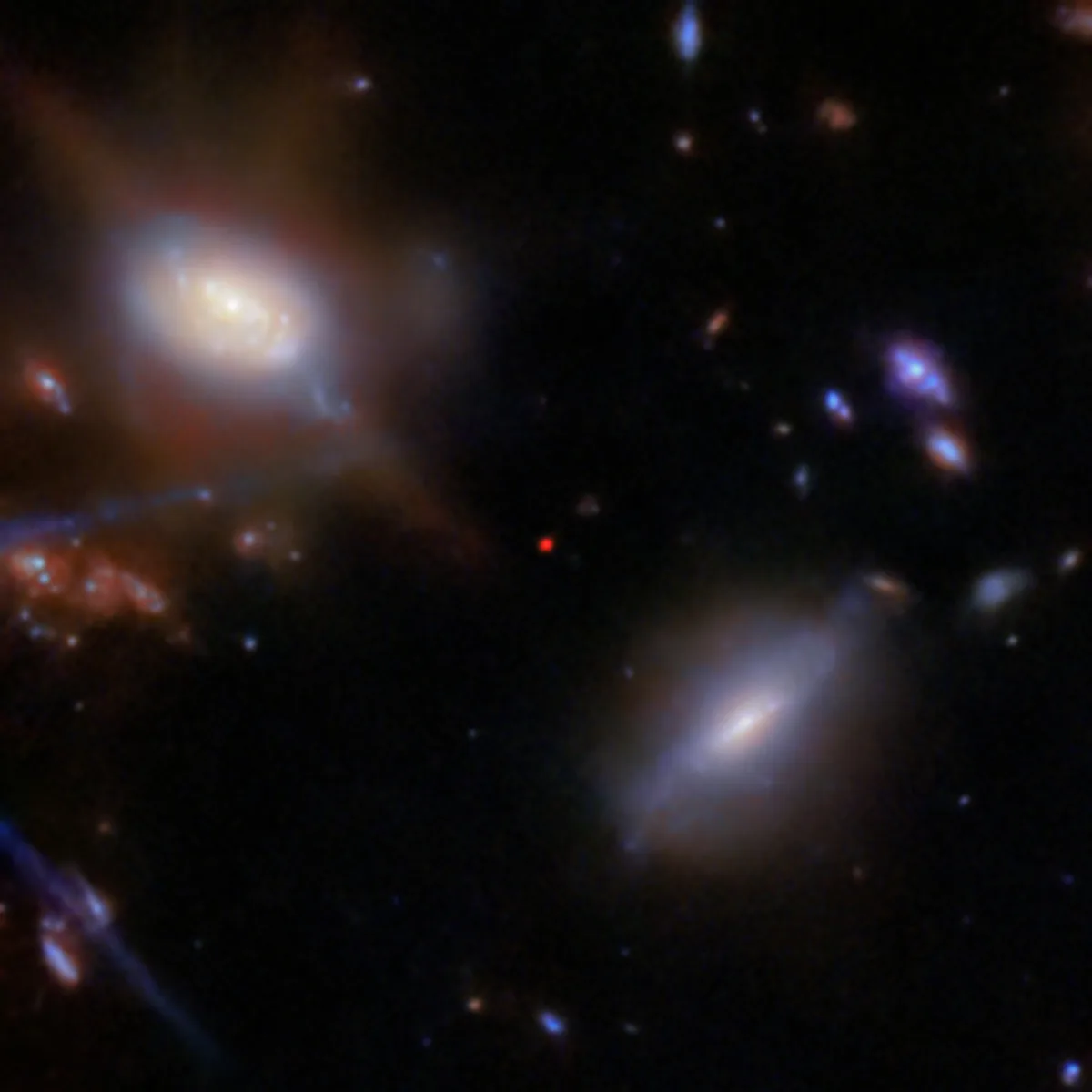
- Spectroscopic redshift:
- z = 13.05 ± 0.01
- Category:
- JADES · GOODS-S
JADES-GS-z13-1-LA's redshift comes from a single feature measured precisely: the Lyman-alpha emission line at 1.7084 µm, detected by Witstok et al. (2025) with NIRSpec's prism. ESA/Webb and NASA date it to 330 million years after the Big Bang.
The paper's abstract rounds the redshift to 13.0; the ranked value, 13.05 ± 0.01, is the published line measurement, which NASA's caption also uses. This is the Lyman-alpha redshift; the authors caution that the galaxy's systemic redshift is probably slightly lower, because resonant scattering shifts the line.
Source: Witstok et al. 2025, Nature 639, 897–901
JADES-GS-z13-0
JWST NIRSpec PRISM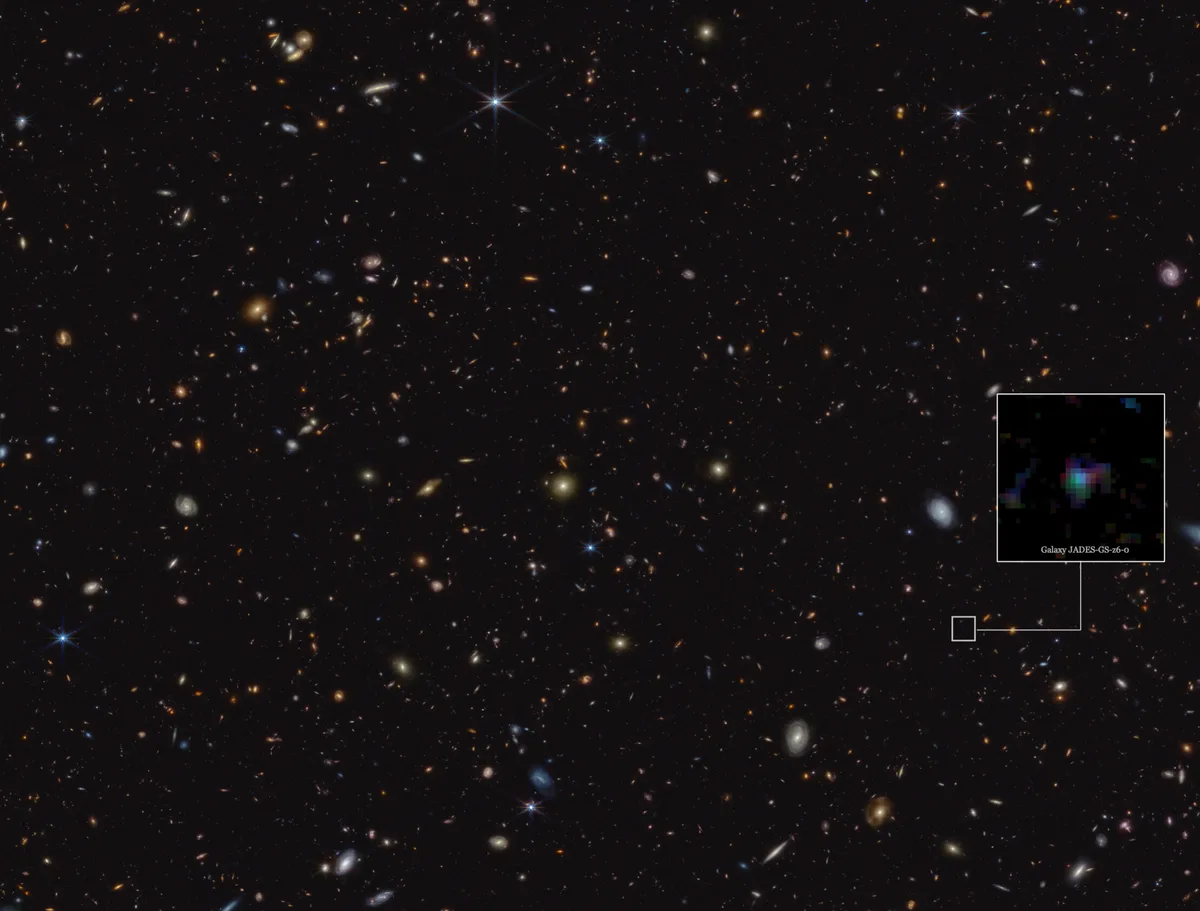
- Spectroscopic redshift:
- z = 13.20 (+0.04/−0.07)
- Category:
- JADES · GOODS-S
JADES-GS-z13-0 was one of the first four galaxies confirmed in the JADES programme, by Curtis-Lake et al. (2023) from its Lyman-alpha break in NIRSpec prism spectra; Hainline et al. (2024) later refined the value. The confirming paper gives no age for this galaxy individually: it presents its four galaxies collectively as seen within 450 million years of the Big Bang, so no per-galaxy age is printed here.
Confirmed in December 2022, it is the earliest-announced spectroscopic confirmation in this top 10.
Source: Curtis-Lake et al. 2023, Nature Astronomy
PAN-z14-1
JWST NIRSpec PRISM- Spectroscopic redshift:
- z = 13.53 (+0.05/−0.06)
- Category:
- Pure-parallel NIRCam imaging
PAN-z14-1 was picked out of Webb's pure-parallel NIRCam imaging and confirmed by Donnan et al. (2026) with NIRSpec prism spectra, from modelling of its Lyman-alpha break.
Its confirming paper describes it as a large and luminous galaxy with weak emission lines, and as the fourth most distant galaxy known when it was confirmed in January 2026.
Source: Donnan et al. 2026, arXiv:2601.11515
JADES-GS-z14-1
JWST NIRSpec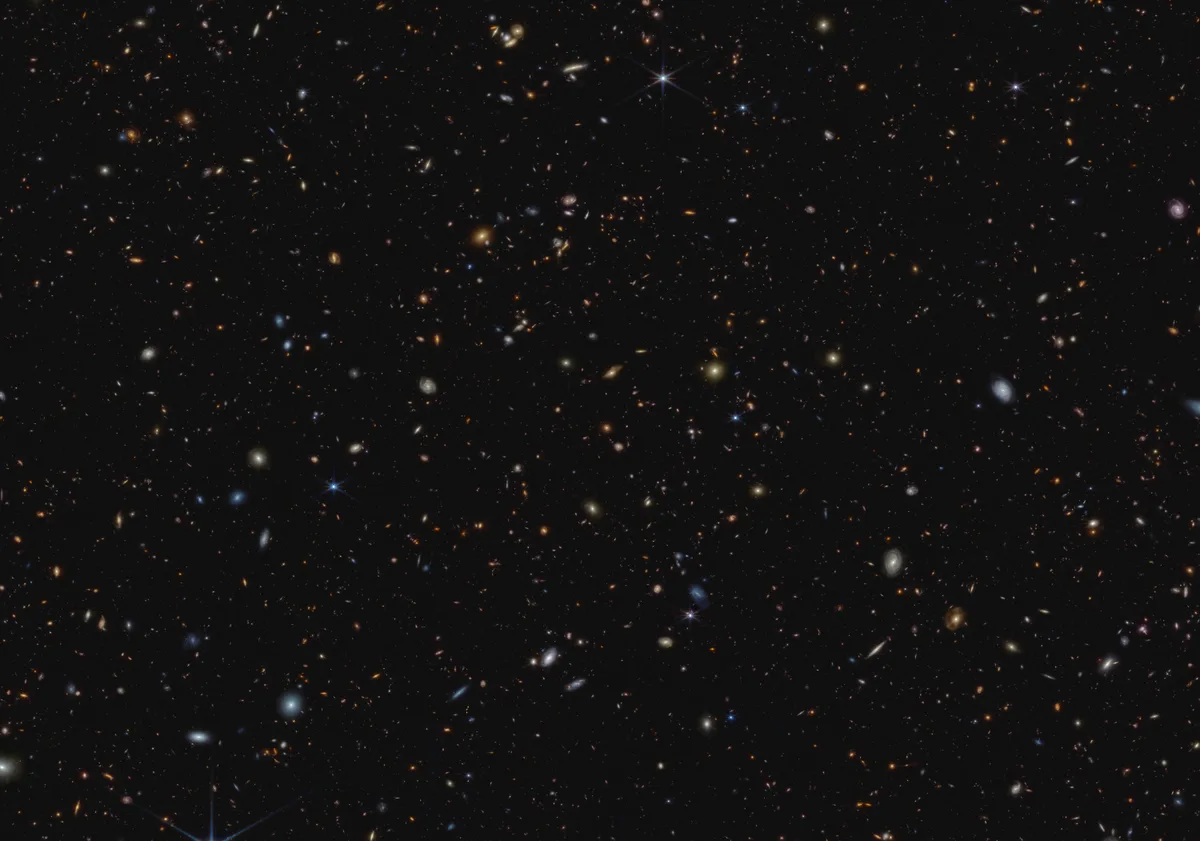
- Spectroscopic redshift:
- z = 13.90 ± 0.17
- Category:
- JADES · GOODS-S
JADES-GS-z14-1 was confirmed alongside JADES-GS-z14-0 by Carniani et al. (2024) from its Lyman-alpha break in NIRSpec prism spectra. The Nature paper states that the pair shows luminous galaxies were already in place 300 million years after the Big Bang.
Announced on 30 May 2024 together with JADES-GS-z14-0, which went on to hold the distance record until MoM-z14.
Source: Carniani et al. 2024, Nature 633, 318–322
JADES-GS-z14-0
ALMA (ranked value); JWST NIRSpec (original confirmation)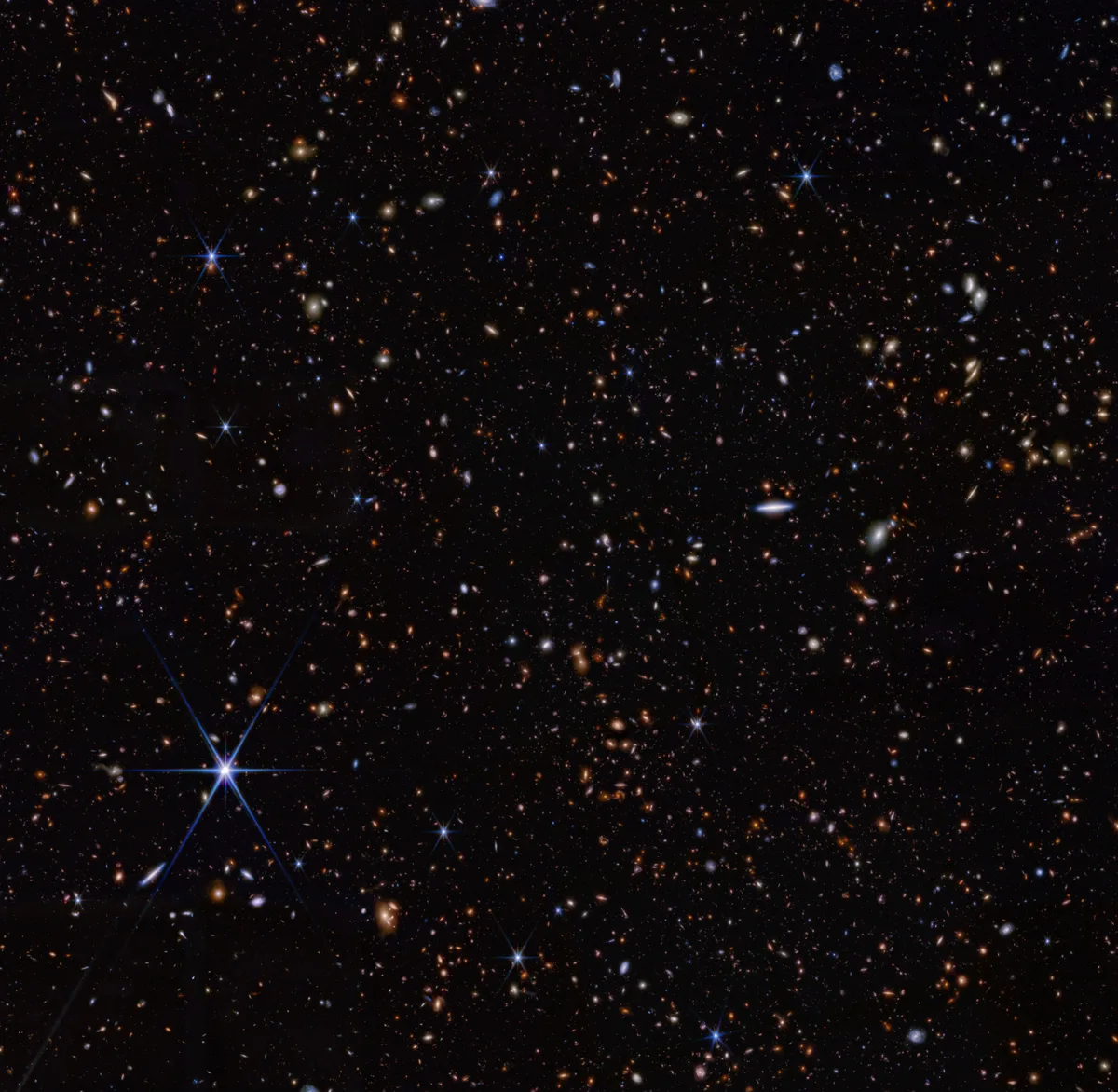
- Spectroscopic redshift:
- z = 14.1793 ± 0.0007
- Category:
- JADES · GOODS-S
JADES-GS-z14-0 held the distance record from May 2024 until MoM-z14. Its ranked redshift is ALMA's: Schouws et al. (2025) detected the [OIII] 88 µm line at 6.6σ and measured 14.1793 ± 0.0007. Schouws et al. describe the galaxy as seen “a mere 300 Myr after the Big Bang”.
It was first announced at 14.32 (+0.08/−0.20) from the Lyman-alpha break in JWST spectra (Carniani et al., 2024); the ALMA line measurement refined it to 14.1793. It ranks second under either value.
Source: Schouws et al. 2025, ApJ 988, 19 (ALMA)
MoM-z14
JWST NIRSpec/PRISM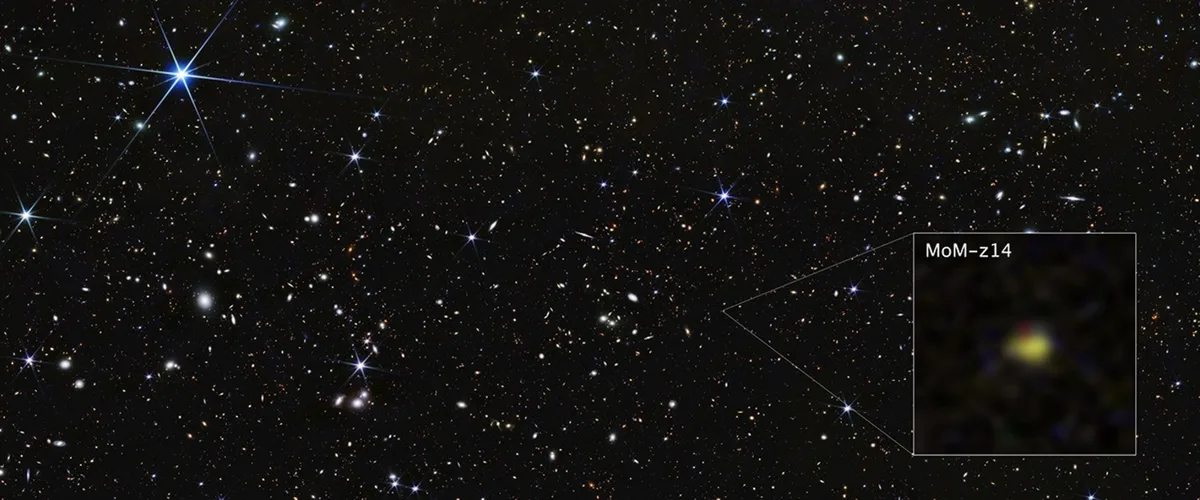
- Spectroscopic redshift:
- z = 14.44 (+0.02/−0.02)
- Category:
- MoM survey · COSMOS field
MoM-z14 is the current record holder, confirmed by Naidu et al. with JWST's NIRSpec prism in the “Mirage or Miracle” survey of the COSMOS field, from a sharp Lyman-alpha break and five rest-ultraviolet emission lines. The paper and NASA both date it to 280 million years after the Big Bang.
NASA announced the record on 28 January 2026, noting that its light has travelled about 13.5 of the universe's estimated 13.8 billion years. The confirming paper was first posted in May 2025.
Source: Naidu et al. 2026, Open Journal of Astrophysics; arXiv:2505.11263
What the numbers tell us
Every galaxy in this top 10 has a spectroscopically confirmed redshift above 11.4. The pre-JWST record holder, GN-z11 at 10.6034, no longer makes the top 10.
- Data period:
- Spectroscopic confirmations published through November 2026
- Last updated:
- November 20, 2026
- Sources:
- Naidu et al. 2026 (MoM-z14); Schouws et al. 2025 and Carniani et al. 2024 (JADES-GS-z14-0 and JADES-GS-z14-1); Curtis-Lake et al. 2023 and Hainline et al. 2024 (JADES-GS-z13-0); Donnan et al. 2026 (PAN-z14-1); Wang et al. 2023 (UNCOVER-z12); Witstok et al. 2025 (JADES-GS-z13-1-LA); D'Eugenio et al. 2024 (JADES-GS-z12-0); Castellano et al. 2024, with Zavala et al. 2024 and 2025 (GHZ2); Arrabal Haro et al. 2023 and Larson et al. 2026 (Maisie's Galaxy); Planck Collaboration 2020 (age of the universe); Gott et al. 2005 (radius of the observable universe).
- Source links:
- Naidu et al. 2026: MoM-z14 (arXiv:2505.11263)
- Schouws et al. 2025: ALMA redshift of JADES-GS-z14-0 (arXiv:2409.20549)
- Carniani et al. 2024: JADES-GS-z14-0 and z14-1 (arXiv:2405.18485)
- Curtis-Lake et al. 2023: JADES-GS-z13-0 (arXiv:2212.04568)
- Donnan et al. 2026: PAN-z14-1 (arXiv:2601.11515)
- Wang et al. 2023: UNCOVER-z12 (and tentative UNCOVER-z13)
- Witstok et al. 2025: JADES-GS-z13-1-LA (arXiv:2408.16608)
- D'Eugenio et al. 2024: JADES-GS-z12-0 (arXiv:2311.09908)
- Arrabal Haro et al. 2023: Maisie's Galaxy (arXiv:2303.15431)
- Larson et al. 2026: deep follow-up of Maisie's Galaxy (arXiv:2607.08749)
- NASA: Webb pushes boundaries of the observable universe (MoM-z14 image)
Only spectroscopically confirmed redshifts are ranked: distances estimated from images alone (photometric redshifts) are excluded, because they have produced false records, most famously CEERS-93316, announced at about 16.45 and later shown by spectroscopy to be a dusty galaxy at 4.912. Galaxies are ranked by their current best published spectroscopic value; where a later paper revised a redshift (JADES-GS-z14-0: 14.32, then 14.1793; JADES-GS-z12-0: 12.63, then 12.482; Maisie's Galaxy: 11.416, then 11.408), the revised value is used and the original is noted in the entry. A spectroscopic redshift is not always the galaxy's systemic redshift: the 13.05 for JADES-GS-z13-1-LA comes from its Lyman-alpha emission line, and its authors note the systemic redshift is probably slightly lower. UNCOVER-z13, reported at 13.079, is excluded because its discovery paper describes it as a plausible candidate and a tentative detection rather than a robust confirmation. GHZ2 and GLASS-z12 are the same galaxy and are counted once. Ages after the Big Bang are quoted only where the confirming paper or its institution states one, in that source's cosmology; none were calculated for this ranking, and no age is printed for JADES-GS-z13-0 because its paper states none for the galaxy individually. Image credits are as given by NASA, STScI, ESA/Webb, ALMA and the CEERS team; three JADES entries and UNCOVER-z12 use official images of their survey fields, as their captions state; no free-licence image of PAN-z14-1 was available.
Figures marked as estimates are based on publicly available information and may vary from other published sources.
Frequently Asked Questions
MoM-z14, with a spectroscopically confirmed redshift of 14.44 (+0.02/−0.02). It is seen as it was 280 million years after the Big Bang. NASA announced the record on 28 January 2026; the confirming paper is by Naidu et al. (2026).