The World's 10 Biggest Chip Companies by Revenue in 2025
Ranked by the revenue each company reports for its chip business in its latest fiscal year. AI has put NVIDIA far ahead of every other chipmaker.
Quick Answer
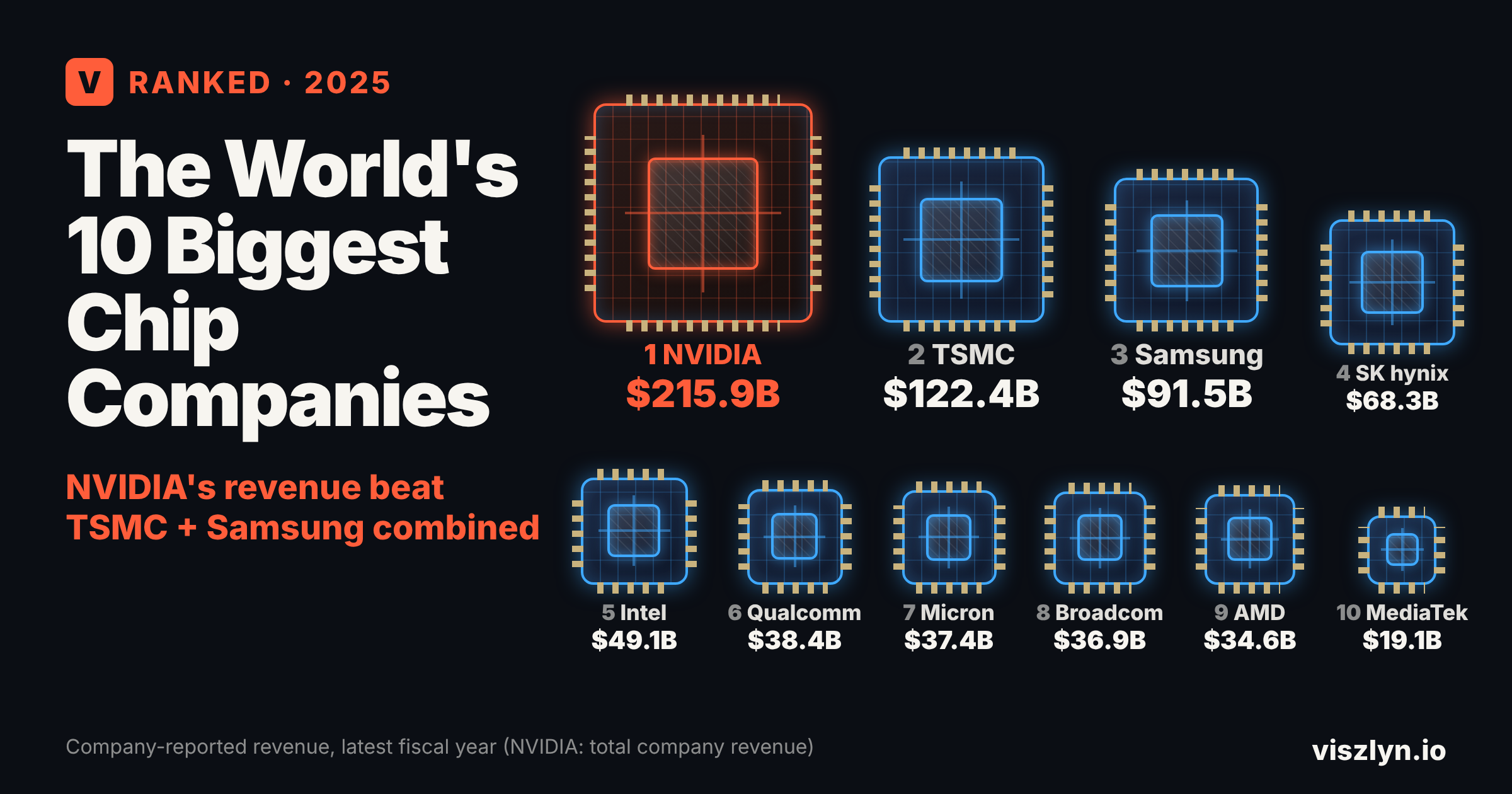
NVIDIA is the world's biggest chip company by reported revenue, with $215.9 billion in its fiscal year ended January 2026, up 65%. That is NVIDIA's total company revenue, which includes complete systems and software as well as chips. TSMC, which manufactures chips for other companies, is second with $122.4 billion, and Samsung's chip division is third with about $91.5 billion. NVIDIA's data center business alone brought in $193.7 billion. These are company-reported figures, not a standardized measure of chip sales like Gartner's.
This ranking uses the revenue each company reports for its chip business, or for the whole company where chips are its main business, in its latest full fiscal year. It is not a standardized market-share ranking: for NVIDIA, for example, the figure is total company revenue, which also includes complete data center systems and software. For companies that also sell other things, only the semiconductor part is counted: Samsung's Device Solutions division, Intel's product segments, Qualcomm's chip business (QCT) and Broadcom's semiconductor segment. Companies end their fiscal years at different times, from August 2025 (Micron) to January 2026 (NVIDIA), so the periods don't line up exactly. TSMC is included even though it is a foundry, a contract manufacturer that makes chips designed by other companies, including NVIDIA, AMD and Apple.
AI made NVIDIA the giant of the chip industry
NVIDIA's revenue rose from $130.5 billion to $215.9 billion in one fiscal year. Its data center business, which sells the processors and networking used to train and run AI, accounted for $193.7 billion of that, up 68%. AI demand is also lifting memory makers: SK hynix's revenue rose about 47% and Micron's about 49%, helped by high-bandwidth memory (HBM) used in AI chips.
Company-reported revenue used in this ranking, latest fiscal year (US$ billions)
Source: Company annual results (latest fiscal year)NVIDIA's figure is total company revenue, including systems and software. For other diversified companies, the ranking uses the stated chip division or segment. These figures are not a standardized measure of chip sales. Tap any company to jump to its full breakdown below.
Ranked #10 to #1
- Reported revenue:
- $19.1 billion
- Category:
- Taiwan · Chip designer
- Revenue sources:
- Smartphone processors, smart TV and Wi-Fi chips
MediaTek's net sales were NT$596.0 billion in 2025 (US$19.1 billion, as the company states it), up 12.3% from 2024.
It is one of only two Taiwanese companies in the top 10, alongside TSMC, which manufactures many of MediaTek's chips.
Source: MediaTek consolidated financial statements, 2025
- Reported revenue:
- $34.6 billion
- Category:
- United States · Chip designer
- Revenue sources:
- Data center processors and AI accelerators, PC chips, gaming, embedded
AMD's revenue was $34,639 million in 2025, up 34.3% from $25,785 million in 2024.
Its data center segment, which includes its AI accelerators, brought in $16.6 billion, up 32%, about half of AMD's total revenue.
Source: AMD 2025 annual results
- Reported revenue:
- $36.9 billion
- Category:
- United States · Chip designer
- Revenue sources:
- Custom AI chips, networking, broadband and wireless chips
Broadcom's semiconductor segment brought in $36,858 million in its fiscal year ended November 2, 2025, up 22.5%. This excludes $27,029 million from its infrastructure software business (VMware).
Broadcom says its AI revenue reached $20 billion in fiscal 2025, up 65%, from custom AI chips and networking products.
Source: Broadcom fiscal 2025 results
- Reported revenue:
- $37.4 billion
- Category:
- United States · Memory
- Revenue sources:
- DRAM, high-bandwidth memory (HBM), NAND flash storage
Micron's revenue was $37,378 million in its fiscal year ended August 28, 2025, up 48.9%, the second-fastest growth in the top 10 after NVIDIA.
Micron says its HBM and other data center memory products together brought in $10 billion in fiscal 2025. Because its fiscal year ended in August, its figures don't include the last four months of 2025.
Source: Micron fiscal 2025 results
- Reported revenue:
- $38.4 billion
- Category:
- United States · Chip designer
- Revenue sources:
- Smartphone processors, automotive and IoT chips
Qualcomm's chip business (QCT) brought in $38,367 million in its fiscal year ended September 28, 2025, up 15.6%. This excludes its patent licensing business (QTL).
Qualcomm's Snapdragon processors are used in many of the world's Android smartphones, its biggest chip market.
Source: Qualcomm fiscal 2025 results
- Reported revenue:
- $49.1 billion
- Category:
- United States · Chip designer and manufacturer
- Revenue sources:
- PC processors, data center and AI chips
Intel's product segments (Client Computing and Data Center and AI) brought in $49,147 million in 2025. Including its foundry business, Intel's total revenue was $52,853 million.
Intel is the only company in the top 10 whose chip revenue fell, down 0.7% from $49,471 million in 2024.
Source: Intel 2025 annual results
- Reported revenue:
- $68.3 billion
- Category:
- South Korea · Memory
- Revenue sources:
- DRAM, high-bandwidth memory (HBM), NAND flash storage
SK hynix's revenue was a record ₩97.1 trillion in 2025 (about $68.3 billion), up 46.8% from ₩66.2 trillion in 2024.
SK hynix says its revenue from high-bandwidth memory, used in AI processors, more than doubled in 2025.
Source: SK hynix FY2025 results
- Reported revenue:
- $91.5 billion
- Category:
- South Korea · Memory, chip design and manufacturing
- Revenue sources:
- Memory chips, smartphone processors, contract manufacturing (Samsung Foundry)
Samsung Electronics' chip division (Device Solutions) had sales of ₩130.1 trillion in 2025 (about $91.5 billion), up 17.2% from ₩111.1 trillion in 2024.
Samsung's figure includes Samsung Foundry, its contract manufacturing business, which it does not report separately.
Source: Samsung Electronics FY2025 results
- Reported revenue:
- $122.4 billion
- Category:
- Taiwan · Foundry (contract manufacturer)
- Revenue sources:
- Manufacturing chips designed by other companies, including NVIDIA, AMD and Apple
TSMC's net revenue was NT$3,809.05 billion in 2025 (US$122.42 billion, as the company states it), up 31.6% in New Taiwan dollars.
TSMC doesn't design its own chips; it manufactures them for other companies, which is why some industry rankings, such as Gartner's, leave it out.
Source: TSMC 4Q25 Management Report
- Reported revenue:
- $215.9 billion
- Category:
- United States · Chip designer
- Revenue sources:
- AI data center processors and networking, gaming GPUs, automotive
NVIDIA's revenue was $215,938 million in its fiscal year ended January 25, 2026, up 65% from $130,497 million the year before. This is NVIDIA's total reported company revenue, not a standalone chip-sales figure.
Its data center business brought in $193.7 billion, about 90% of NVIDIA's total, and more than TSMC's entire revenue. NVIDIA's revenue is about 1.8 times TSMC's, and more than TSMC and Samsung's chip division combined ($214.0 billion).
Source: NVIDIA fiscal 2026 results
What the numbers tell us
AI is reshaping the chip industry's ranking. NVIDIA's revenue is now about 1.8 times TSMC's, and AI memory has pushed SK hynix (+46.8%) and Micron (+48.9%) to the fastest growth in the top 10 after NVIDIA. Intel, long the industry's biggest chipmaker, is the only top-10 company whose chip revenue fell. Gartner, which measures chip sales by calendar year and excludes foundries, also ranks NVIDIA first for 2025, at $125.7 billion, making it the first chip vendor ever to pass $100 billion in Gartner's ranking.
- Data period:
- Each company's latest full fiscal year ending between August 2025 and January 2026
- Last updated:
- November 10, 2026
- Sources:
- Company annual results and filings: NVIDIA (fiscal 2026, ended January 25, 2026), TSMC (4Q25 Management Report), Samsung Electronics (FY2025 results and 2025 4Q Interim Report, Device Solutions division), SK hynix (FY2025 results), Intel, Qualcomm, Micron, Broadcom, AMD and Texas Instruments (earnings releases and SEC filings), MediaTek (2025 consolidated financial statements). Comparison: Gartner, "Gartner Says Worldwide Semiconductor Revenue Grew 21% in 2025" (January 12, 2026). Exchange rate: Federal Reserve H.10.
- Source links:
- NVIDIA: Financial Results for Fourth Quarter and Fiscal 2026
- TSMC 4Q25 Management Report (PDF)
- Samsung Electronics: Q4 and FY2025 results
- Samsung Electronics: 2025 4Q Interim Report (DS Division full-year revenue) (PDF)
- SK hynix: FY25 financial results
- MediaTek: 2025 consolidated financial report (PDF)
- Gartner: Worldwide semiconductor revenue grew 21% in 2025
- Federal Reserve H.10: Korean won exchange rates
Companies are ranked by the revenue they report for their chip business in their latest full fiscal year. These are company-reported figures, not a standardized measure of semiconductor sales, so they are not directly comparable to market-share estimates such as Gartner's. NVIDIA's figure is its total company revenue, which includes complete data center systems and software as well as chips. Where a company has other businesses, only its chip segment is counted: Samsung's Device Solutions division (which includes Samsung Foundry), Intel's Client Computing and Data Center and AI segments (excluding Intel Foundry), Qualcomm's QCT segment (excluding licensing) and Broadcom's semiconductor solutions segment (excluding software). NVIDIA, AMD, Micron, SK hynix, MediaTek and TSMC are counted by total revenue. Fiscal years differ: NVIDIA's ended January 25, 2026, Broadcom's in November 2025, Qualcomm's in September 2025 and Micron's in August 2025; the rest follow the calendar year. TSMC and MediaTek US dollar figures are as the companies state them. Samsung and SK hynix figures are converted by Viszlyn at the 2025 average rate of ₩1,421.40 per US dollar (Federal Reserve H.10). Percentage changes are calculated from the reported figures in each company's own currency. This ranking includes TSMC, a foundry; without it, Texas Instruments ($17.7 billion) would be 10th. Gartner's calendar-year ranking counts only chip sales and excludes foundries, so its figures differ (for example, NVIDIA $125.7 billion); Gartner also includes Apple ($24.6 billion, its estimate of Apple's in-house chips), which reports no chip revenue of its own.
Figures marked as estimates are based on publicly available information and may vary from other published sources.
Frequently Asked Questions
NVIDIA, with revenue of $215.9 billion in its fiscal year ended January 2026, up 65%. Its data center business, which makes processors for AI, accounted for $193.7 billion.